


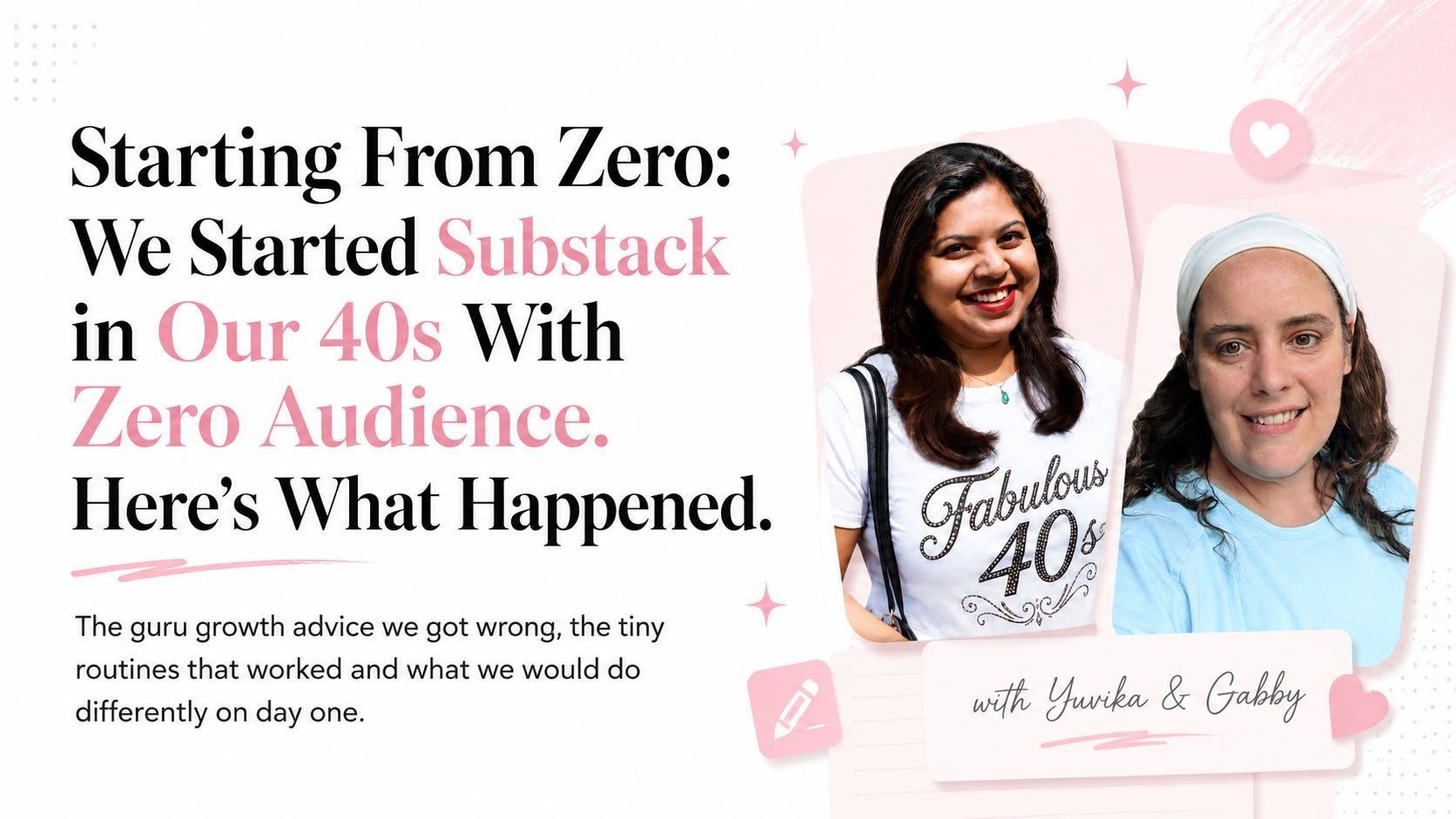
A collab post by Yuvika Iyer (Quiet Creator) and Gabby Gazdag (The Side Door).
If you’re starting again in your forties or fifties, you already know this feeling.
Maybe this is your third reinvention. Maybe your fifth. You’ve built things before. Some worked. Some quietly fell apart.
And here you are again, staring at an empty Substack page, wondering if it’s too late to begin one more time.
We get it. We’re right here too.
We’re two women in our forties who started over on Substack a couple of months ago at the same time, in two very different corners of it. We met here as beginners, and we’re both still figuring it all out!
One of us writes about building a quiet, no-hustle creative life as an introvert (Quiet Creator). The other writes about building real side income after decades of working on someone else’s dream (The Side Door).
Different niches. Same beginner nerves.
And we’re still in it. We’re not writing this from the other side of some shiny success story. We’re a couple of months in, still figuring it out, still a little surprised every time something works.
So we skipped the “here’s how we made it” post. Instead, we asked each other the ten questions we most wanted answered when we were exactly where you are now. Then we answered them honestly, side by side.
No hustle. No gatekeeping. No pretending we have it all figured out. Just two beginners talking openly, in case it helps you begin too.
Pull up a chair. This one is for you.
I’m joined by by Yuvika Iyer from Quiet Creator. She writes about the quiet side of creating online, where peace of mind matters more than hustle.

1. What finally made you hit publish, after wanting to for so long?
Yuvika: Honestly, a big part of it was that my old work was quietly drying up. I’d spent about nine years as a resume writer and LinkedIn profile strategist. I worked with four companies and had my own direct clients coming in through LinkedIn and referrals.
Then AI got good, really fast, and that work started shrinking a lot. So I began thinking about writing somewhere else, building something that was actually mine, and seeing if I could grow an audience for myself.
Substack was that experiment. And the way I finally got past the fear of publishing was just lowering the stakes. I couldn’t face writing a whole post, so I told myself I’d write one small, honest Note instead. That was my way in.
Gabby: My husband lost his job. It wasn’t a romantic “fulfil my destiny” moment, just real financial pressure that needed a real answer. We started a Substack for him first, a cooking newsletter, and I launched The Side Door to document the whole experiment.
About two months in, I realized two things: building two publications at once is brutal, and working with your partner on the same project is a different kind of brutal. So the cooking newsletter became his, and The Side Door became mine.
2. What did you believe about growing on Substack that turned out to be wrong?
Yuvika: That you need an audience before anyone will read you.
I really thought you had to show up with a list already, or some kind of proof that you were worth listening to. That turned out to be completely wrong. Almost all of my growth has come from Notes, and mostly from strangers who’d never heard of me until one honest little post showed up in their feed.
You don’t build the audience first and then write. Writing honestly, out in the open, is how your people actually find you.
Gabby: I came in thinking it was a newsletter platform and nothing else. The social layer caught me completely off guard. Notes, the reader relationships, the comment threads, none of that was on my radar.
I also assumed quantity would matter the way it does on Facebook: post more, grow faster. It doesn’t work that way here.
The other thing I got wrong was the community. Substack turned out to be the last corner of the internet where people my age can exist without dancing videos, without algorithmic suppression for linking elsewhere, and without the pressure to be online every hour. I had no idea that was what I was walking into.
3. How did you land on your topic, and how sure were you at the start?
Yuvika: When I started, I was writing about happiness through ancient, timeless wisdom, the kind you find in Eastern philosophy and a few other traditions. But gradually, writing about happiness started to feel like a lot of pressure.
I’m an introvert, and honestly I’m rarely, if ever, happy all the time. Happiness comes in waves for me, it goes up and it comes down.
So I kept thinking, how can I keep writing about happiness when I’m not actually happy all the time? That’s when I started wondering why not rebrand to something that fits my personality better. I like my quiet time. I like thinking things through and creating slowly, and I’m completely anti-hustle.
I’m a mom of two, always balancing work and life, and all that growth advice about posting ten times a day is just not something I can do.
So I thought, why not write about building something quietly online instead? That felt much more like me. And that’s how, in month two, even as I write this, I’ve been rebranding to Quiet Creator.
So no, I wasn’t sure at the start at all. Your topic isn’t something you lock in on day one. It’s something you grow into as you go.
Gabby: I landed on it through the situation I was in, not through a strategy session. I was 48, my husband was unemployed, and I was trying to figure out how to build something that could earn real money.
That became the topic, because it was my life. I wasn’t sure at all at the start. I just knew I could document the experiment honestly, and I thought people in the same position might find that useful.
The confidence came later, from readers who showed up and said, this is exactly where I am.
4. What’s actually driving your growth right now?
Yuvika: For me it comes down to a small 30-minute Notes routine I’ve followed almost since the beginning. I start by spending about 15 minutes reading other people’s Notes and actually replying to them properly. Not “great post” or “love this,” but real, thoughtful comments that might genuinely be useful to the person who wrote it, and to their readers too.
Then I post my own Note. After that, I hang around in my own comments for another 15 minutes or so, talking to whoever shows up, and I keep replying to other people’s Notes and restacking the ones I love. I don’t really like the word “engagement,” I prefer “conversations,” because that’s what it actually is.
I’m not posting my Note and running away. I’m staying, and talking to people, the way you would if you were standing right in front of them. That whole thing takes me about half an hour a day. I really credit that little routine for my growth, and for the lovely relationships I’ve built here. I’ve somehow built this small, warm, genuinely supportive community. I love it.
Gabby: Notes, and being social on the platform rather than just publishing into it. Reading other people’s work, leaving real comments, restacking things I liked.
That is what moved the needle, not posting frequency.
Once I stopped treating Substack like a broadcast channel and started treating it like a room full of people I actually wanted to talk to, the numbers shifted.
5. How do you keep showing up when the numbers are small?
Yuvika: I keep reminding myself that small is not nothing, it’s just early. When I did a tiny beta launch of my tool, I sold seven copies in the first 24 hours, and that was to a limited group of only sixteen writers. Seven!
But a few weeks before that I’d been too scared to publish anything at all, so seven real people felt like a genuine win. I stopped performing for some big invisible audience and started writing for the handful of people who are actually here. When you write for the ten who are really in the room, the rest slowly takes care of itself.
Gabby: In the early weeks, showing up was a necessity. We needed the income, so stopping wasn’t an option.
Then something changed.
I downloaded the app so I could read and connect on the go, and it stopped feeling like work. Now I’m at around 100 subscribers, and I’ll be honest, I cherish this number. I can still reply to every single person who writes in.
I know that window will close at some point, so I’m making the most of it while it’s here.

6. What tools or AI do you actually use each week, and what’s hype?
Yuvika: You really don’t need a fancy setup. I built my own little Notes-analytics tool simply because Substack hid the one number I wanted to see, and I think that instinct of solving your own small problem matters more than any shiny app.
I use AI to think out loud and get unstuck, but never to write in my voice for me. The thing I’d skip is all the elaborate automation and scheduling systems people set up before they’ve even found their voice. Keep it simple when you start.
Gabby: Claude is my main partner, not for generating content but for thinking through structure, pressure-testing ideas, and catching the things I’m too close to see.
I did my entire Notes analysis by screenshotting 38 individual stats pages and handing the data over to find the patterns. It took a while, but it worked.
I’ve also set it up as a kind of strategic filter: if I’m about to spend time on something that won’t move the needle, it tells me. And then sometimes I ignore it anyway. ;)
7. Should beginners think about money early, or wait?
Yuvika: I did put out a paid tool around day 50, but the thing is, it came straight out of a real frustration I’d been ranting about on Notes, not from some monetization plan. My newsletter itself is free. My take is to earn trust first, keep your writing free in the early days, and let anything paid grow out of a genuine problem your readers actually have.
Money too early, before people even know your voice, just adds a pressure you don’t really need yet. (Gabby and I don’t fully agree here, which is honestly part of the fun.)
Gabby: This is where Yuvika and I disagree, which is rare.
I’d say think about money from day one if you can. I turned on my paid tier and published my first paid post while the newsletter was still new. People tend to adapt to whatever you establish at the start. If you give everything away indefinitely, that becomes the expectation.
The thing I got wrong wasn’t the timing, it was the sequence. I launched without a product ready and built the offer while the newsletter was already running. It worked out, but I’d do it differently next time: have something to sell before you start, or at least know clearly what it will be.
8. What growth advice do you now ignore?
Yuvika: The etiquette-as-a-checklist thing. There’s so much “here are the 11 rules of Substack” advice out there, and if you read it the wrong way it’ll freeze you on day one. I ignore the pressure to get all of it perfect.
I just pick one small habit, like posting one honest Note a day, and let the rest become second nature by being a good neighbour in the room. I also ignore the strict “post daily at 9am or the algorithm will punish you” fear. Just show up honestly. That’s really the whole thing.
Gabby: Post Notes three times a day. That advice was everywhere on YouTube when I started, so I tried it, and nothing moved.
One solid Note matters more than three forgettable ones, and neither matters as much as actually talking to people. Commenting on their work, showing up in their threads, restacking things worth sharing. Almost nobody said this clearly, but it was obvious from the first week: you have to listen before anyone will listen to you.
9. If you started over tomorrow, what’s the one thing you’d do differently?
Yuvika: I’d start with Notes much sooner and stop waiting to feel ready. I lost a few weeks polishing my niche and my plan, when the real growth came from simply showing up and being honest in public.
If I could go back, I’d publish the small messy thing on day one instead of day thirty. You don’t feel ready and then start. You start, and the readiness slowly follows.
Gabby: Have the product ready before hitting publish on anything.
I spent the first two months building the newsletter and the offer in parallel, which meant I was always slightly behind myself. The newsletter was seeding interest in a product that didn’t exist yet.
Start with what you’re selling, then build the content that leads people toward it.
And one more thing: I started because I had to, and looking back, that pressure was the best thing that could have happened. Without it, I’d still be waiting to feel ready. You never feel ready. That isn’t a personal failing, it’s just how starting works.
10. What’s one tiny action a reader can take today?
Yuvika: Open Notes right now, find the most honest thing you’ve posted so far, and write one more in that same voice. Just one. Don’t schedule it, don’t over-think it, don’t wait for the perfect idea.
And if you’ve never posted a Note before, then this is it: write one true sentence about where you actually are today and hit publish. That one small habit did more for me than anything clever I tried.
Gabby: Open the posts you actually read this week and leave three real comments on them. Not “great post,” but one sentence about what landed for you, or a question the piece left you with.
You’ll get more from those three comments than from posting a Note nobody sees yet, because you haven’t given anyone a reason to look for you. Attention on this platform moves toward the people who give it first.
Before you go
If there’s one thing we both want you to take from this, it’s that you’re not behind, and you already know enough to start. We’re proof that you can begin quietly, in your forties, with no audience and no plan, and still build something real and warm here.
We’re both still figuring it out too, and honestly, that’s the whole point.
If you found this helpful, the kindest thing you could do is come and say hello to both of us.
Yuvika here: if you want a practical, honest guide to building real side income after years of building someone else’s dream, subscribe to Gabby’s The Side Door. She’s the real deal.
Gabby here: and if you’re an introvert craving a slower, quieter way to create online without the hustle, Yuvika’s Quiet Creator is your place.
And here’s a small challenge before you close this tab.
Pick any one of the ten questions above and answer it for yourself in the comments. Even one honest sentence. We both read every single one, and we’ll reply.

This has to be the most grounded and approachable advice I’ve seen on growing organically on here. What I appreciate most, is that neither of you over-hyped your growth stories and strategies. Neither of you is presenting yourselves as know-it-alls.
It’s refreshing seeing creators who are early on but just a little further ahead than those of us newer to the platform, talk about how they’ve grown without the hustle culture. Sometimes when a larger account is giving advice, it can feel so out of reach. Seeing creators like yourselves gives evidence that it’s possible for the rest of those who are newer.
Truly a great colab and I enjoyed reading it!